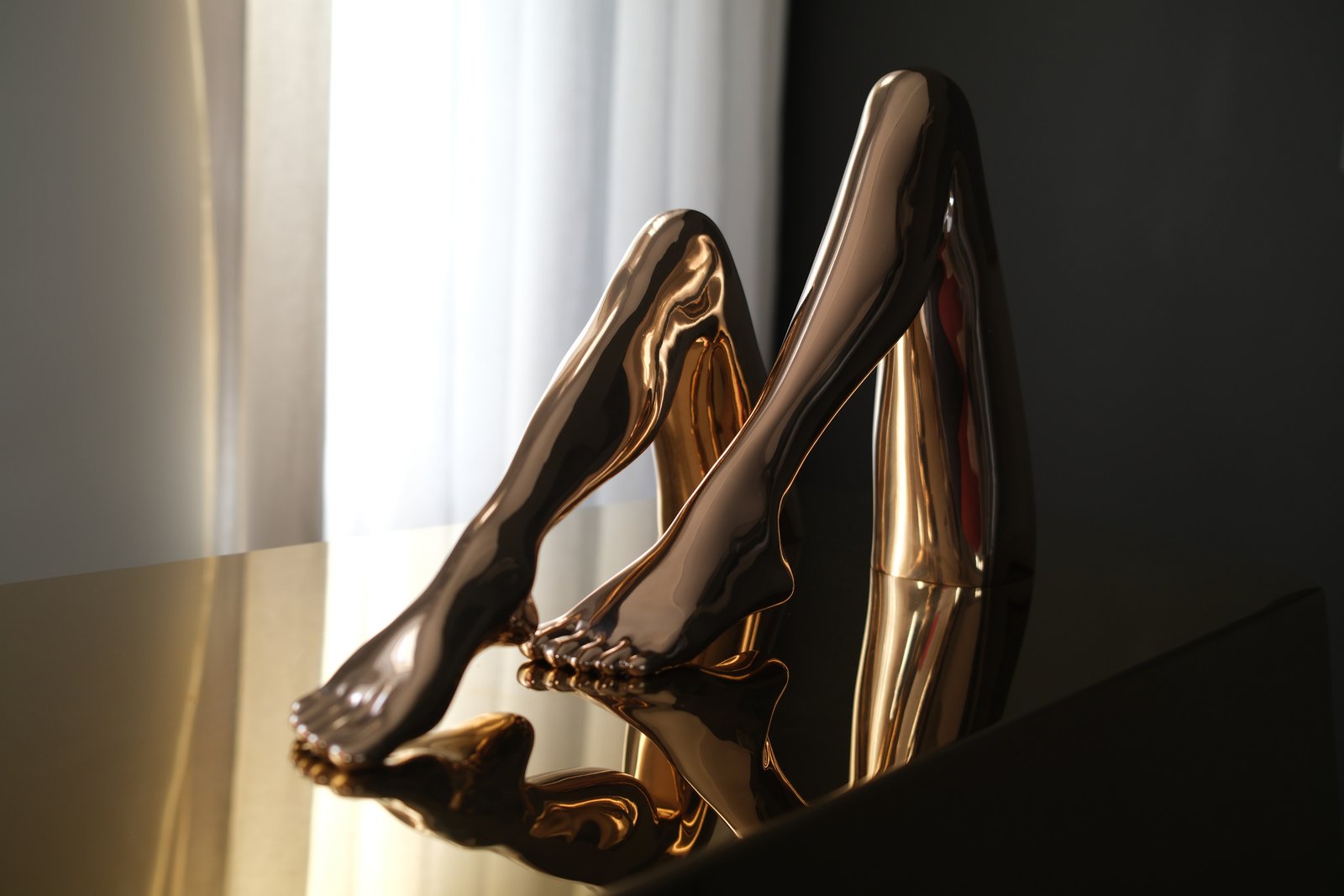
In Ozanne Princen’s Counterpoise, two sculpted legs rise and recline across a reflective surface. Bent knees give the composition its peaks; long shins carry the eye towards delicately articulated feet. The bronze is still, but its polished finish catches the surrounding light, lending the form a sense of change. It is an intimate study of how much movement a resting body can retain.
The Belgian artist’s work now has a Paris address through Galerie Agnès Dechanteloup at 71 rue du Faubourg Saint-Honoré. Announced on 29 September, the representation opens with Counterpoise and Scarlet Noir, two bronze works that approach her recurring subject, the leg, through different compositions and finishes. Together, they offer a focused introduction to a practice informed by dance, material and the spaces an object inhabits.
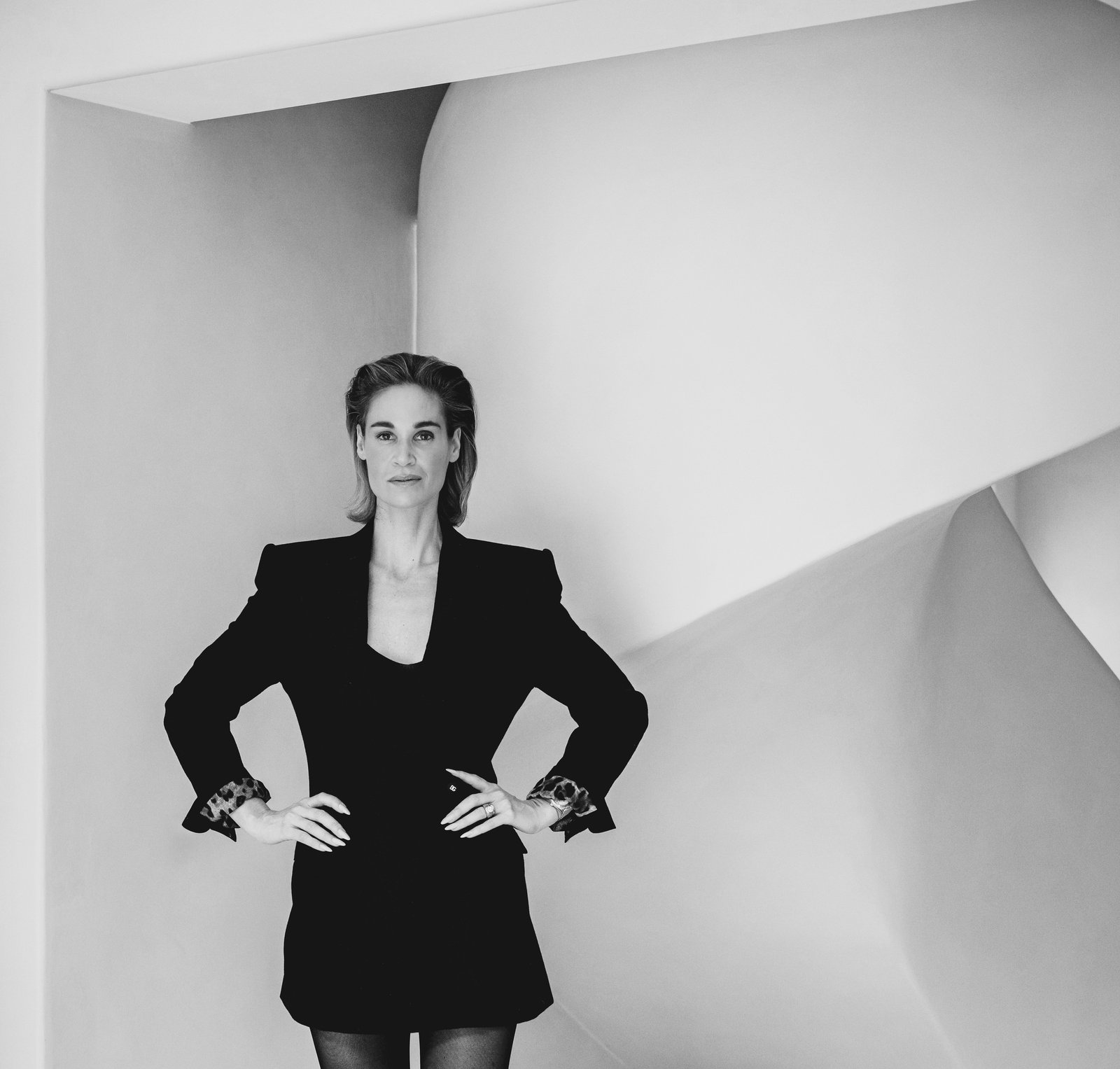
Princen’s relationship with movement began long before sculpture. Her studio biography traces her ballet training to the age of three, followed by studies in Modern History and Cultural Studies, teaching history and philosophy, and co-founding an events company. She began formal sculpture studies during the pandemic. That varied path helps place her work at an intersection of bodily expression, composition and atmosphere.
A vocabulary of balance
The leg is a particularly economical way to explore those connections. A knee can establish an angle, a calf describe a curve and a foot change the apparent balance of the whole. By isolating these elements, Princen gives the viewer room to consider a gesture without the narrative of a complete figure. Femininity is present in the work’s attention to the body, while the reduced forms invite a more open reading of strength and vulnerability.
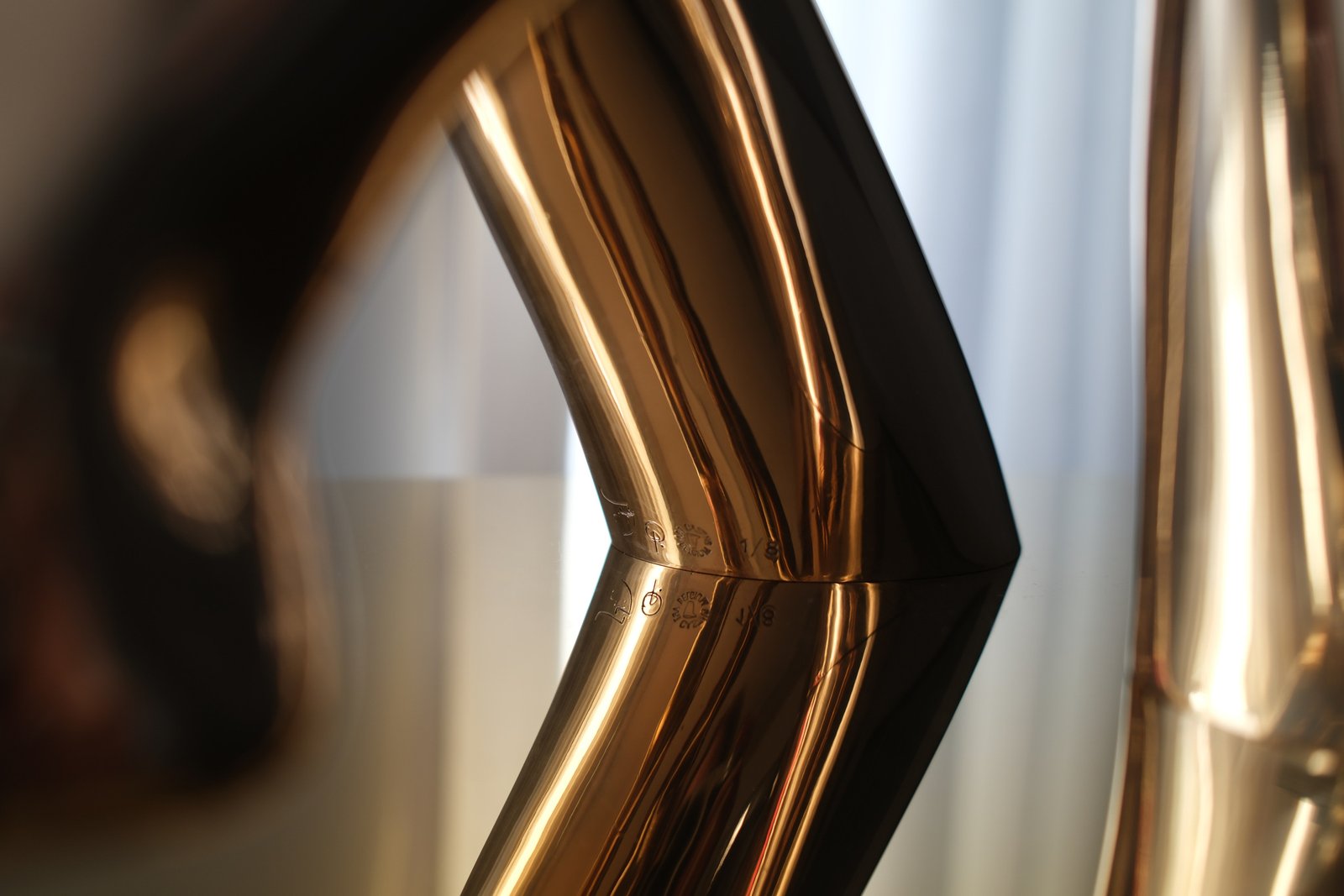
Counterpoise is made using lost-wax casting, and its polished bronze finish allows reflections to travel across the contours. The studio’s catalogue specifies a configuration of two separate sculptures, making their relationship part of the composition. Their contrasting heights and lengths create a rhythm that is visible even in repose.
The work’s scale rewards close looking. In its published specifications, the taller element measures 27 centimetres high and 36 centimetres deep; the lower one is 19 centimetres high and 51 centimetres deep. Those proportions make the exchange between elevation and extension tangible. The studio lists the polished-bronze version in an edition of 50, with two artist’s proofs.
Two ways of holding the eye
Scarlet Noir offers a more vertical treatment of the same bodily vocabulary. A deep red lacquer gives its bronze surface a dark, glossy intensity, and the elongated form draws attention upwards. Listed within Princen’s Silhouettes Éternelles collection, the 55-centimetre-high work is an edition of 12, with two artist’s proofs. Colour becomes a structural part of the encounter, emphasising the silhouette as well as its curves.
The Paris setting has a personal resonance. In the announcement, Princen’s studio describes the city as a longstanding source of inspiration, singling out the deep reds, flowers and layered atmosphere of Hôtel Costes. Dechanteloup, an interior decorator as well as a gallerist, discovered the sculptures independently. The release recalls her immediate response: she “fell in love with the works.”
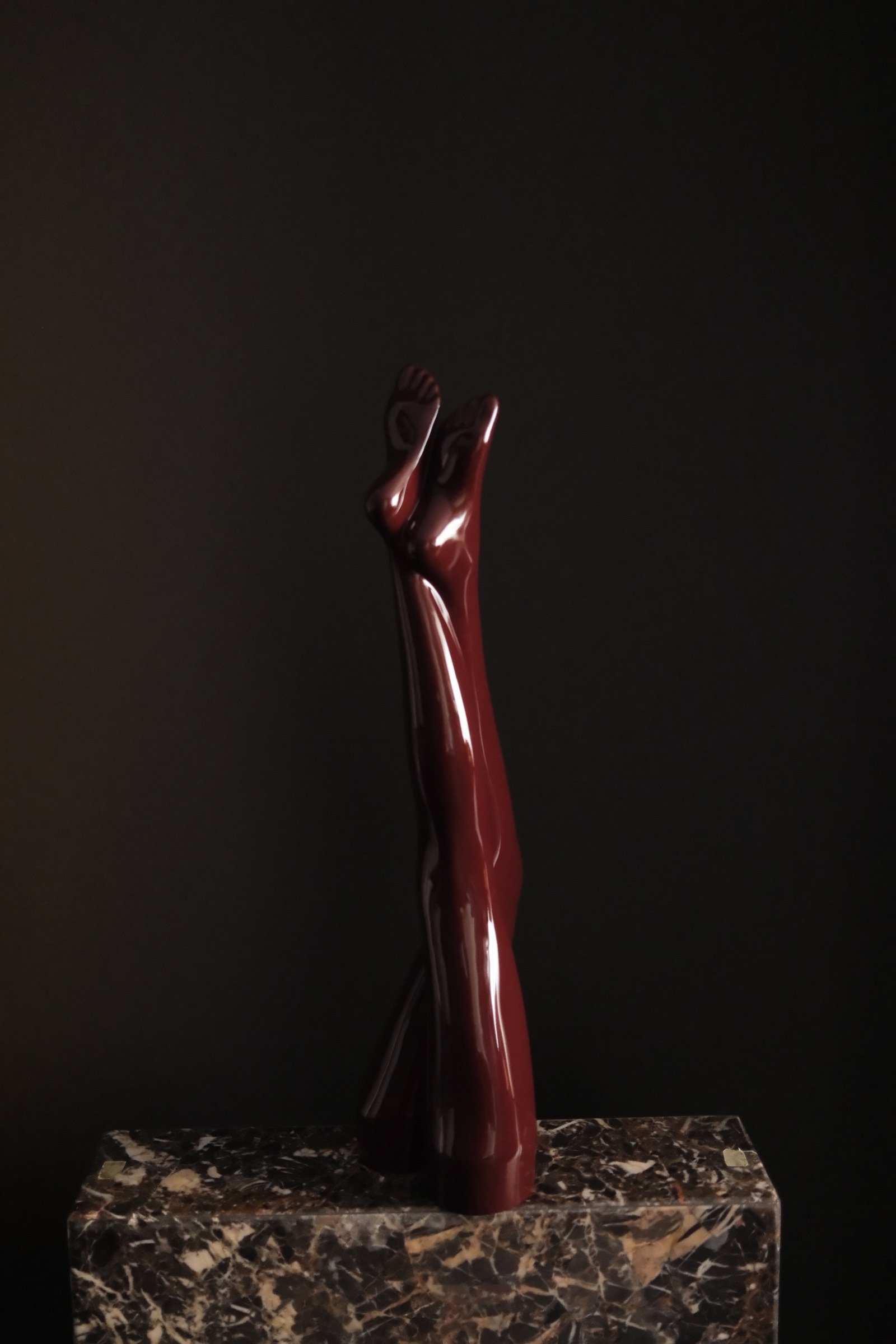
Beyond these bronzes, Princen is extending her material vocabulary into marble and collectible design. Her current Stone & Bronze studies include a green-marble bench and a red-marble reclining form, both presented as concepts. They carry the investigation towards furniture and architectural space, where stone and metal can support, frame and counterbalance one another.
For now, the Paris pairing keeps the focus on sculpture itself: the placement of a knee, the reach of a foot, the way a finish changes the reading of a curve. Princen turns those small observations into objects with a clear physical presence, giving a fleeting gesture the time to be examined.