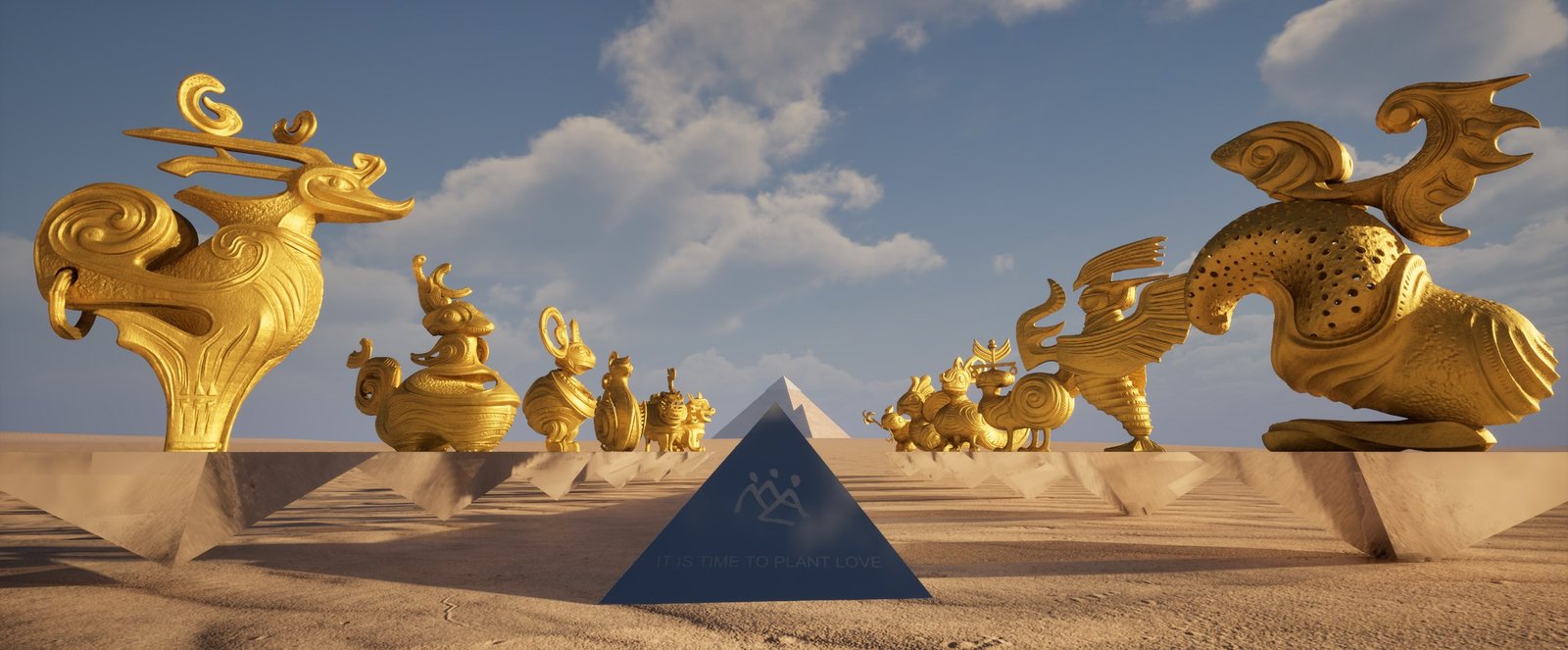
A procession of twelve mythical figures will lead towards the pyramids this November, giving Jiang Qiong Er’s latest installation the shape of a journey. Conceived for the Giza Plateau, It Is Time to Plant Love brings the Franco-Chinese artist’s interest in shared symbols to a landscape where monumental form has carried meaning for millennia.
The work is part of Forever Is Now 06, the sixth edition of Art D’Égypte’s contemporary art exhibition. The organiser lists the exhibition’s overall dates as 4–28 November 2026. Jiang’s September announcement makes a more precise distinction: she is scheduled to inaugurate her work with a performance on 4 November, ahead of an official exhibition opening on 7 November accompanied by the installation’s illumination.
A pathway between cultures
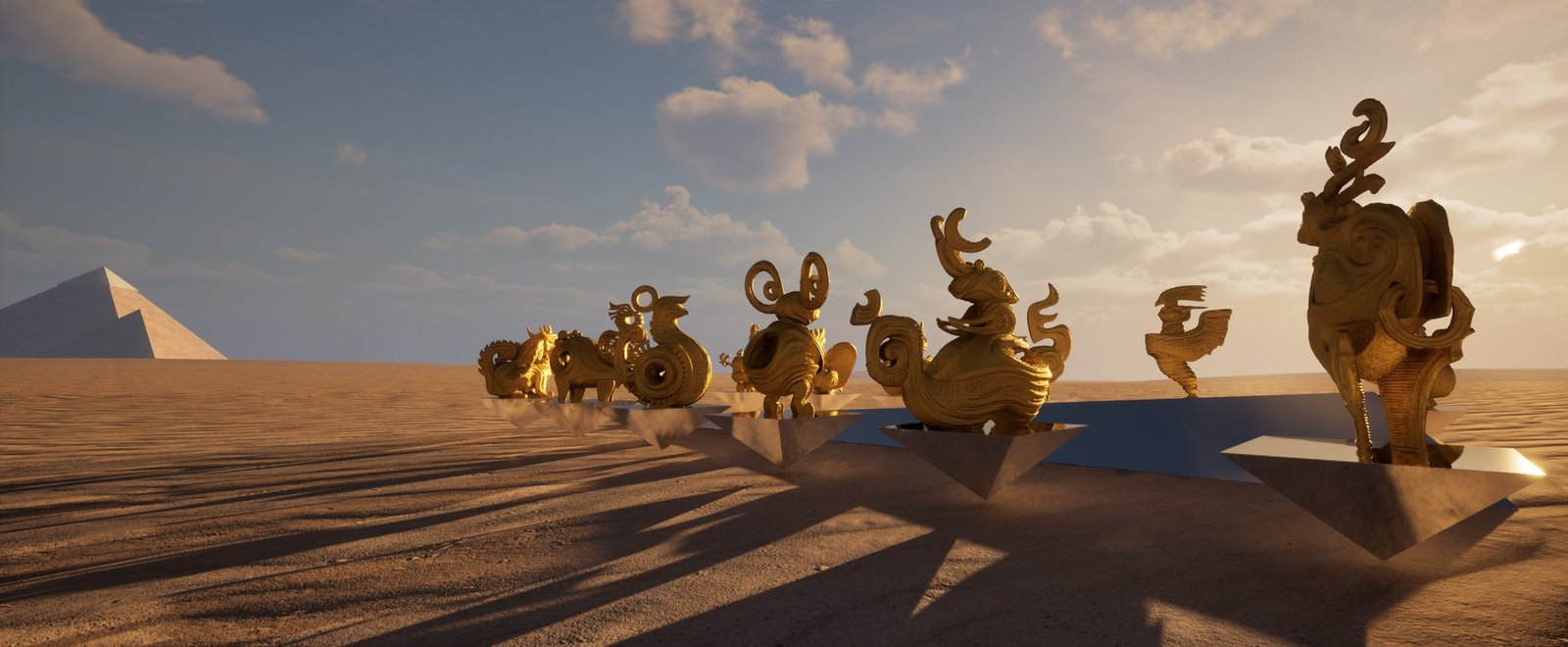
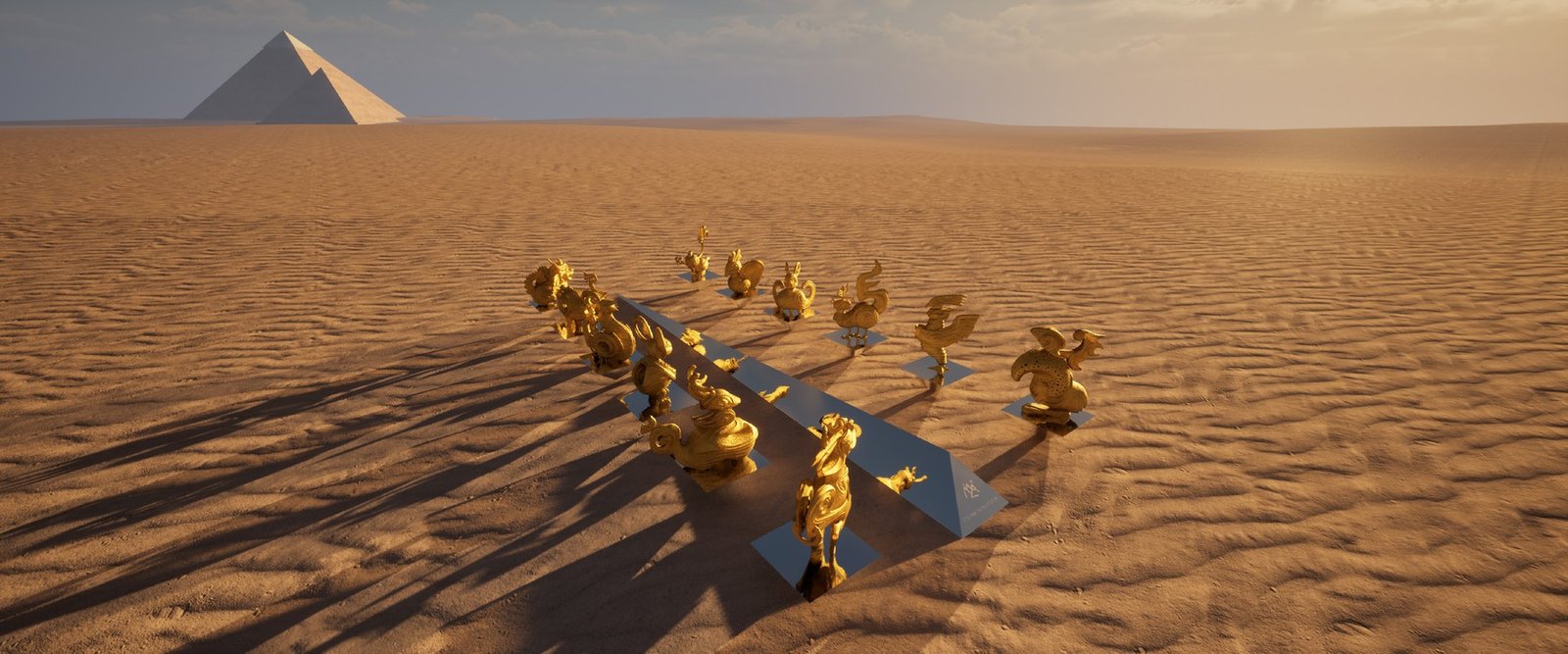
The twelve figures draw on mythical creatures from different cultural traditions. Positioned along a route towards the pyramids, they are intended to accompany visitors through the site. Movement is integral to the proposal: the work unfolds through the act of passing between its forms, with the ancient monuments providing a point of orientation.
In the project renderings, gold-coloured creatures rise above angular bases. Curving horns, wings and coiled bodies give each figure a distinct silhouette, while long shadows extend across the sand. Seen together, the forms establish a rhythm along the pathway. These visualisations offer a preview of the planned installation, whose relationship with the changing light and scale of Giza will be experienced on site.
Writing a symbol for love
Alongside the procession, Jiang has developed a contemporary symbol for love, drawing inspiration from Egyptian hieroglyphs, Chinese characters and other ancient writing systems. The proposal asks how different visual histories might contribute to a form that can be recognised across borders, while retaining a connection to their particular origins.
This inquiry belongs to what the artist calls “Universal Art”, her exploration of shared values through monumental installation, symbolism, light and place. A question runs through the practice: “How can we live together?” At Giza, it becomes a physical invitation to move through a work shaped by several cultural traditions.
© QEJ Studio
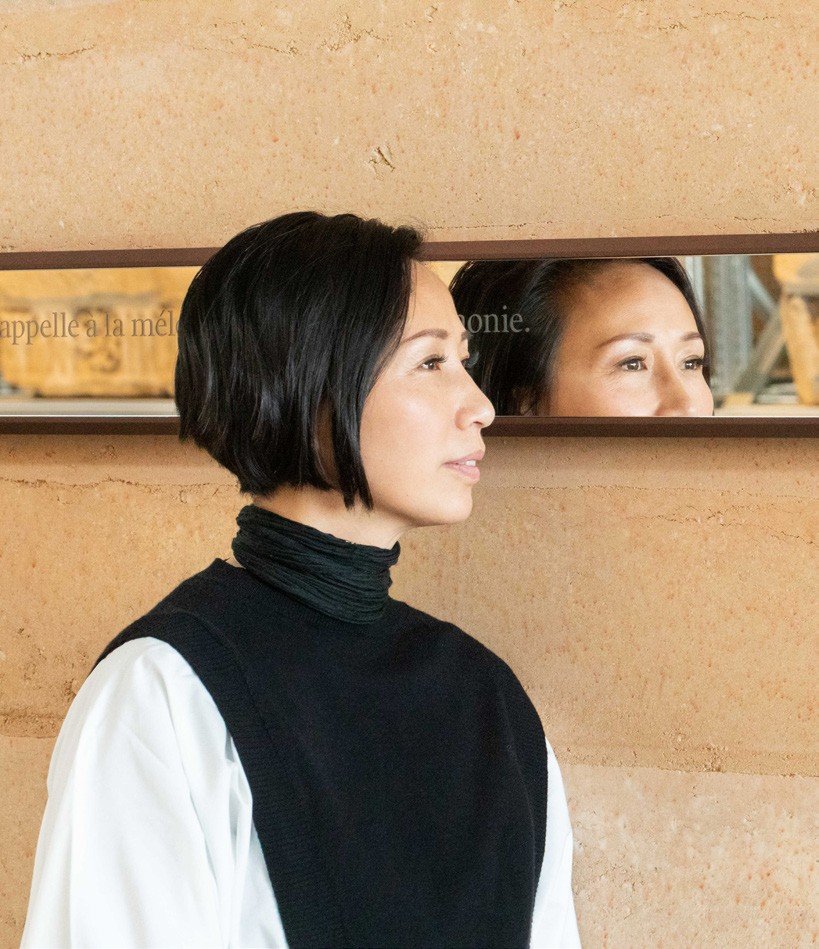
Born in Shanghai and working between China and France, Jiang trained at Tongji University and the École nationale supérieure des Arts Décoratifs in Paris. Her practice connects art, design and craftsmanship. The Giza project continues an engagement with heritage settings that includes Guardians of Time at the Musée Guimet and Breath of Time at the Musée Narbo Via.
Women’s voices at Giza
Founded by Nadine Abdel Ghaffar, Art D’Égypte places women artists at the centre of this year’s edition. Within that programme, Jiang’s contribution proposes an intimate act on a monumental scale: walking, looking and considering what people might recognise in one another. The performance that lends the installation its title will give that idea its opening gesture.