A diamond set into a watch normally has a fixed place. On Chopard’s Happy Diamonds, its position changes with the wrist. Stones drift around the central dial, gathering and separating against a black surface, turning an ordinary gesture into part of the design.
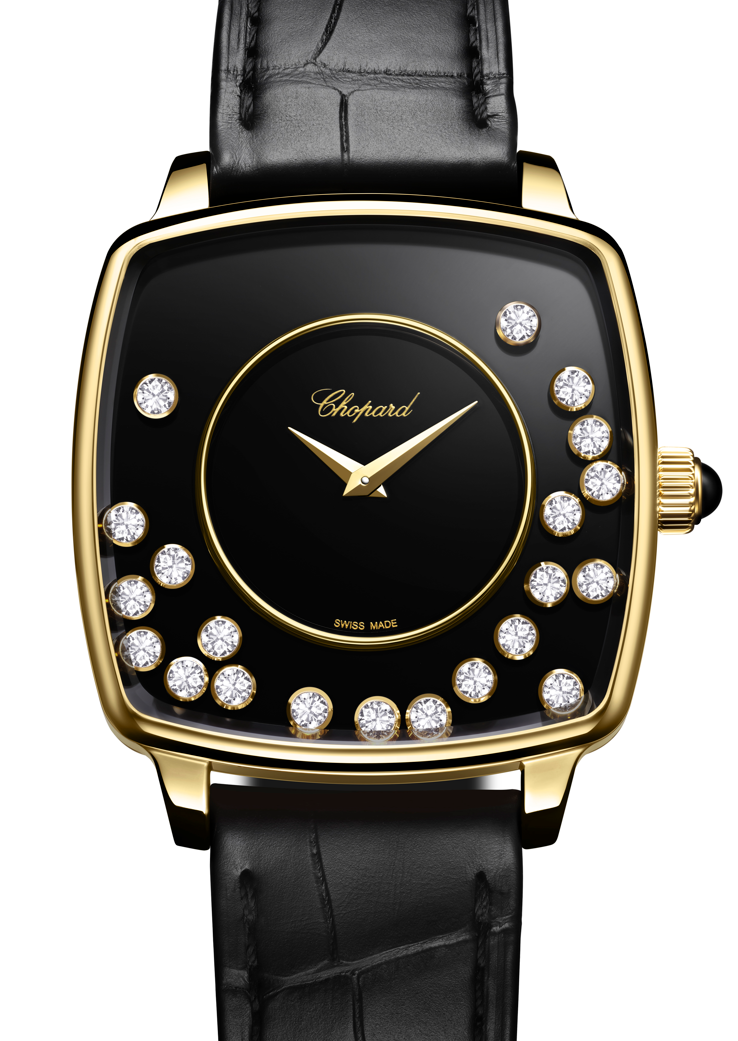
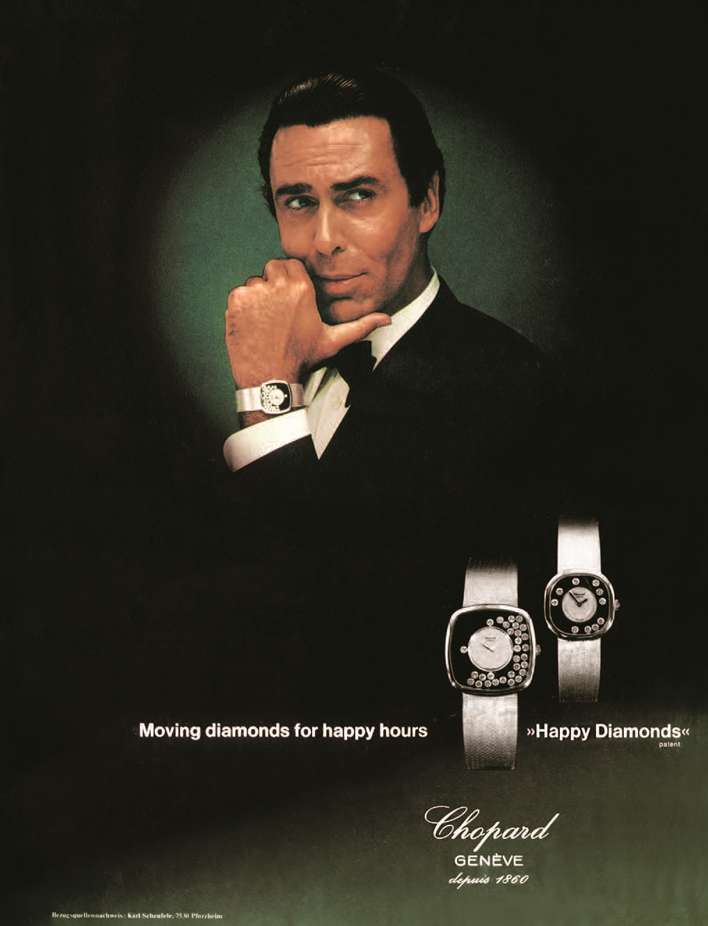
Happy Diamonds Heritage returns to the cushion-shaped watches with which Chopard introduced that idea in 1976. Yellow gold, black onyx and freely moving diamonds give the new editions a remarkably direct visual language. The case supplies the outline; the onyx provides depth; the stones keep the composition from settling into a single arrangement.
The appeal of an unfinished arrangement
The contrast is the point. A conventional gem-set bezel fixes its sparkle around the edge of a watch, establishing a pattern that remains intact. Here, the diamonds occupy the space between two sapphire crystals around the time display. Their movement makes the dial’s surrounding field continually variable.
In the larger Heritage watch, that field has room for 21 diamonds. The central hours-and-minutes display remains clear, framed by a fine gold circle. Beyond it, the black onyx gives the moving stones an uncluttered background. In the supplied photographs, they gather near the lower edge and climb one side, leaving other stretches of the surface almost empty.
The cushion case reinforces that balance between order and freedom. Its softened corners retain the geometry of a square without the severity of sharp angles. Rounded contours meet the circle at the centre, while the diamonds introduce forms that belong to neither. The result carries the character of the original design without depending on a complicated dial.
Two sizes, two ways of keeping time
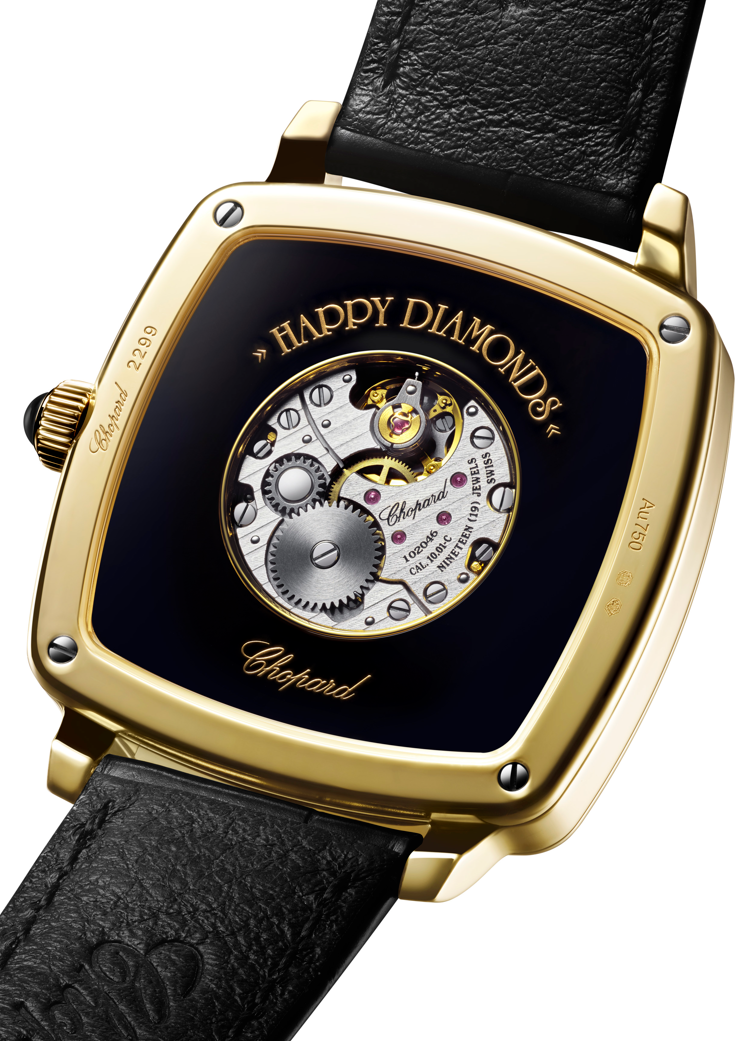
The 34 mm version is made in 18-carat yellow gold and houses Chopard’s hand-wound 10.01-C manufacture movement. Introduced in 2024, the calibre offers a 45-hour power reserve and is visible through an open caseback. It adds a second kind of movement to the watch: the diamonds are animated by the wearer, while the mechanical calibre drives the hands.
Turn the watch over and the presentation changes. The central opening reveals the compact mechanism within a much broader dark surround, edged by gold. On the front, the eye follows the diamonds; on the reverse, it is drawn towards the workings at the centre. The view makes the mechanical version more than a change in scale.
The smaller 24 mm watch uses a quartz movement and carries nine moving diamonds. Its more compact proportions offer a different expression of the same idea. The important distinction is therefore both visual and mechanical: buyers are choosing between two scales, two diamond arrangements and two approaches to winding and timekeeping.
A design that travels beyond the wrist
Chopard extends the Heritage language into jewellery with a signet ring, cufflinks, a pendant and a tie pin that can also be worn as a brooch. Yellow gold and black onyx remain the framework, with moving diamonds enclosed behind sapphire crystal. Translated into these smaller objects, the signature is still recognisable without a pair of hands at its centre.
That adaptability helps explain the design’s endurance. The contrast of dark stone and bright gold supplies a strong outline, but the diamonds introduce an element that cannot be fully composed in advance. They make the object responsive to its wearer.
Half a century after the original Happy Diamonds watches, the Heritage editions return attention to that simple relationship. Their attraction lies in the way a carefully designed frame leaves room for chance: a watch with a clear geometry and an appearance that changes as soon as the wrist moves.